LG CLOiD Robot: Home Setup, Time Savings & Costs
By Mateo Lin • 27th Mar
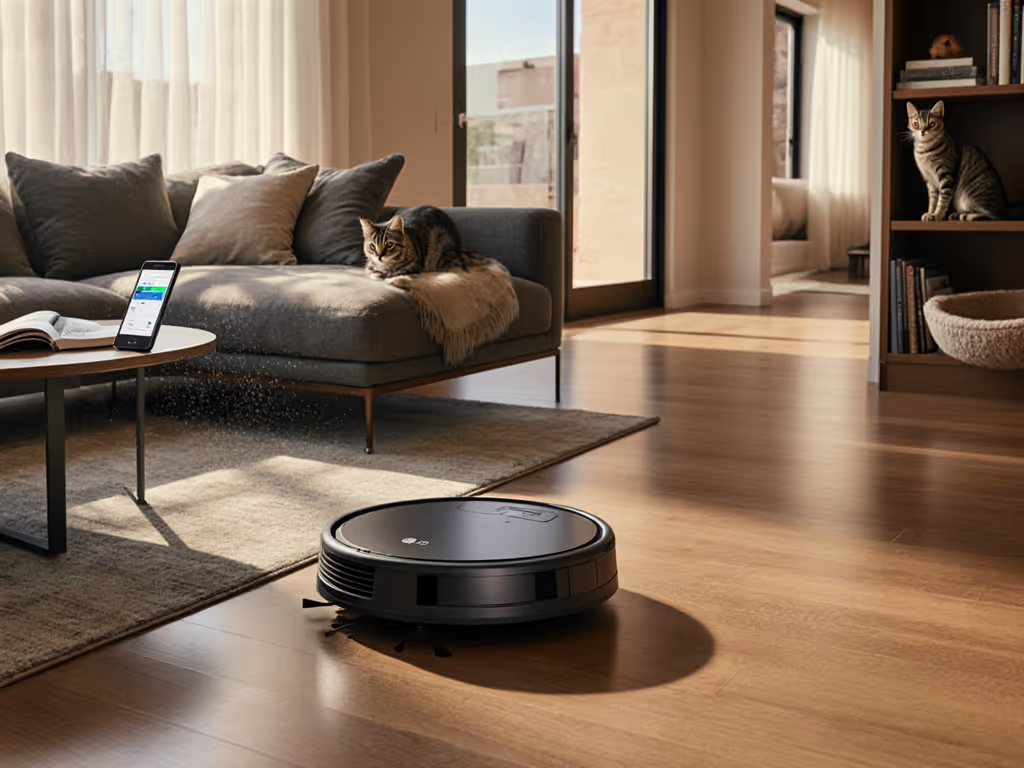
LG's new LG CLOiD robot entered the market in early 2026, promising to tackle household chores from laundry to tidying, but the gap between demo videos and your actual hallway needs careful examination. This is not a vacuum robot. It is a wheeled mobile manipulator designed to coordinate tasks across connected appliances rather than handle floor cleaning independently. Before committing $1,500 or more, you need to know exactly what CLOiD does in a real home, how much labor it actually removes, and whether the setup friction and costs justify the appliance investment.
What LG CLOiD Actually Is (And Isn't)
Understand CLOiD's form factor first. It's a torso with two articulated arms, a head unit, and a wheeled base, not a humanoid and not a floor cleaner. The company positions it as an orchestrator: a mobile AI hub that moves between rooms, interprets voice commands, learns your home layout, and directs LG-connected appliances (washers, dryers, ovens, robot vacuums) to execute tasks.
Each arm has seven degrees of freedom, matching human shoulder-to-wrist mobility. The hands feature five independently actuated fingers, enabling CLOiD to grasp objects from knee level up to shoulder height as the torso tilts. The wheeled base prioritizes stability and cost-effectiveness over mobility range. LG deliberately chose rolling over legged locomotion to reduce tipping risk in homes with children and pets.
Crucially: CLOiD does not perform floor vacuuming itself. It can load laundry, coordinate appliances, and handle light object manipulation. For floor cleaning, it relies on integration with separate LG robot vacuums via the ThinQ smart home ecosystem.
The Core Technology: Physical AI and Integration
CLOiD's decision-making runs on two AI systems: Vision Language Model (VLM) and Vision Language Action (VLA). The VLM translates images and video into structured understanding, while the VLA converts visual and verbal inputs into physical actions like opening doors or transferring objects. These have been trained on tens of thousands of hours of household task data, though LG has not disclosed the specific tasks or failure modes.
This is where skepticism matters. Training on vast datasets does not guarantee performance in a hallway with a pet gate, a runner rug bunching at the threshold, or a laundry basket you've piled with throw blankets. The head unit includes cameras and sensors, but LG's public materials do not specify sensor resolution, depth-perception accuracy, or the bump-map resolution, details that determine whether CLOiD navigates your floor plan reliably or requires frequent rescues.
Integration with LG's ThinQ ecosystem is the core promise: CLOiD acts as a mobile hub directing your connected appliances. If you own an LG washer, dryer, refrigerator, and a robot vacuum, CLOiD can theoretically orchestrate a sequence to pull laundry from the dryer, fold or sort it, coordinate a vacuum cycle, and respond to voice commands across devices. Without a suite of LG appliances, CLOiD becomes a mobile speaker with arms that can move objects, not a housework automaton. For broader, brand-agnostic automation, see our smart home integration guide for how robot vacuums participate in context-aware routines.
Real-World Setup: What Adopters Actually Face
LG has not published setup timelines, dock dimensions, or Wi-Fi strength requirements in detail. The wheeled base uses autonomous driving technology derived from LG's robot vacuum experience, which suggests a learning curve: CLOiD will need to map your home, identify obstacles, and may require furniture repositioning to operate safely.
Dock and footprint are practical constraints. LG has not disclosed exact dimensions, but CLOiD's head unit (with display and camera array) plus a charging dock likely require 3-4 square feet of floor space. In a studio apartment or a home with hallway charging constraints, placement is not trivial.
Wi-Fi dependency is implicit. The robot relies on cloud-based generative AI for voice processing and scene interpretation. A Wi-Fi failure or latency spike will degrade performance. LG has not detailed fallback behavior. Can CLOiD operate with degraded capability offline, or does it halt until connectivity is restored?
Network security and privacy remain opaque. The unit collects video (from its head cameras), audio (for voice interaction), and sensor data on your home layout and appliance use patterns. LG's privacy policy, data retention period, and third-party access rules have not been clearly summarized in product materials. For step-by-step hardening of permissions, cameras, and network settings, read our robot vacuum data security guide.
Time Savings: Minutes Per Week Reality Check
This is where analysis must be rigorous. Claim: CLOiD reduces "time and physical effort required for everyday chores." Translation: minutes saved per week.
Test scenarios that matter:
- Laundry cycle: Move wet clothes from washer to dryer, start the dryer, fold dried clothes 45 minutes later. Human time: ~8 minutes hands-on, ~45 minutes elapsed. CLOiD time: ~3 minutes of arm manipulation plus uncertain transfer accuracy (will it fold, hang, or drop your favorite sweater?).
- Kitchen prep: Load a dishwasher or retrieve items from a high shelf. Human time: ~2 minutes. CLOiD time: ~1 minute of arm motion plus navigation and safety checks.
- Robot vacuum coordination: Trigger a vacuum cycle on schedule. Human time: 30 seconds. CLOiD time: voice command processing, navigation to the dock area, initiating the vacuum. Rough parity, no net savings.
LG has not published quantified benchmarks from actual homes. Without independent testing (which is rare for brand-new appliances), you're estimating. A conservative forecast: 10-20 minutes saved per week in a home fully stocked with LG appliances, assuming CLOiD operates without failures. Homes with partial LG integration will see minimal savings.
However, babysitting required, because rescues due to navigation mistakes, object drops, or confused task sequencing can erase those gains. A single rescue per week (manually retrieving CLOiD from a corner it cannot exit, or folding items it mangled) costs 5-10 minutes, flattening the net benefit.
Three-Year Costs: Setup, Hardware, and Hidden Fees
Upfront hardware cost is estimated at $1,500-$2,000 based on LG's positioning as a premium home automation device. This is a capital expense, not a subscription.
Integration costs are implicit. If you don't own LG appliances, you'll face pressure to buy compatible ones to unlock CLOiD's value, such as a washer/dryer pair ($1,200-$2,500), a robot vacuum ($300-$1,500), possibly an LG refrigerator ($1,000+). That quickly becomes a $5,000+ home automation build-out.
Maintenance and consumables are not yet detailed. Based on robot vacuum benchmarks:
- Brush replacement: $50-$150 per brush, possibly yearly. CLOiD's dexterous hands likely include wear-prone components.
- Filter cartridges: unclear; CLOiD doesn't have a dustbin, so filtration demands may be lower.
- Sensor cleaning: routine wipe-downs for cameras and bump sensors, similar to vacuum robots.
- Battery replacement: after 2-3 years of daily use, the battery may degrade. Replacement cost is typically $200-$400.
Subscription services are a gray area. LG has not confirmed whether premium features (advanced voice commands, predictive maintenance, multi-home support) require a paid app tier. Assume $5-$10/month if cloud AI inference is metered.
Three-year total estimate (conservative scenario with one LG appliance already owned and minimal repairs):
- CLOiD unit: $1,750
- Brush/part replacements: $200
- Battery replacement (if needed): $300
- Subscriptions (36 months × $7/month): $252
- Total: ~$2,500
If you're building the full LG ecosystem, add $3,000-$5,000 for compatible appliances. For a realistic look at upkeep and failures that impact ownership math, see our reliability and 3-year cost analysis.
Critical Limitations: Where CLOiD Stumbles
LG's messaging glosses over hard constraints:
Narrow task scope: CLOiD is designed for kitchen, laundry room, and living areas. Bedrooms, bathrooms, and stairs are not mentioned. If your home is multistory or you have a lofted bedroom, CLOiD's wheeled base cannot reach those zones.
Dexterity ceiling: Five-fingered hands are impressive on paper. In practice, CLOiD will struggle with items that require fine pressure sensing, like delicate fabrics, eggs, or full wine glasses. Early robot arm deployments in manufacturing showed that gripper failure (dropping objects, crushing items) is common at commercial automation levels. A home environment, less predictable, compounds this.
Object recognition edge cases: Vision-based AI excels at common items but fails on novel or occluded objects. Pile a chair with a blanket, add a pet toy, and CLOiD may misidentify the task or hesitate, buying no time over human labor.
Noise and nuisance: The actuator motors for a seven-degree-of-freedom arm are not silent. LG has not published decibel ratings. Motor whine during manipulation could be intrusive during naps, video calls, or apartment quiet hours, negating a key appeal of automation.
Lack of real-world testing data: No independent lab or home testing has validated CLOiD's uptime, error rate, or task completion speed. Buying a $2,000 device with zero third-party benchmarks is a leap of faith.
Comparative Context: What Else Is Out There
CLOiD competes in an emerging category, home manipulation robots, not against robot vacuums. Competitors are sparse. Boston Dynamics' Spot is deployed in industrial or research settings, not homes. Sanctuary AI's Phoenix is still in development. Tesla's Optimus prototype exists but is not yet a consumer product.
For practical household automation, most users achieve better results via cheaper, modular approaches:
- Specialized robot vacuums ($300-$1,500) handle floors reliably.
- Robot mops ($200-$800) manage wet cleaning.
- Smart plugs and routines ($10-$100) automate appliance sequencing without a mobile unit.
- Lightweight portable tools (cordless vacuums, compact steamers, $100-$400) handle ad-hoc tasks humans still need to perform.
This bundle ($1,500-$3,000 total) covers more actual chores than CLOiD with lower integration friction and zero babysitting. CLOiD's advantage is seamless voice orchestration and the promise of fewer manual tasks, but that promise is unproven at scale.
Setup and Maintenance Outlook
Initial setup will likely consume 2-4 hours: unboxing, docking station placement, home mapping, Wi-Fi pairing, appliance linking, and boundary definition (no-go zones, preferred routes). Firmware updates will be mandatory and may reset map knowledge, a common frustration in robot vacuum ownership. To gauge which brands improve rather than break features over time, check our update reliability guide.
Routine maintenance is estimated at 20-30 minutes monthly: wipe cameras and sensors, check brush wear, clear the path of hazards. This is not onerous but adds friction that undermines the "zero labor" pitch.
Final Verdict: Is CLOiD Worth the Investment?
For early adopters with a full LG appliance ecosystem and deep tolerance for unproven tech: CLOiD offers a cohesive vision of AI-coordinated housework. The design is thoughtful, with a low center of gravity for safety, wheeled mobility for reliability, and articulate arms for versatility. You'll see modest time savings (10-20 minutes per week) if the robot operates without failures, and the novelty factor is undeniable.
For pragmatic households seeking proven time savings: Wait. CLOiD has zero field data. You cannot know uptime, error rates, or real-world task completion time. Investing $2,000+ on a device with no independent testing, when modular solutions (vacuums, mops, smart plugs) deliver proven results for less, is speculative.
For renters or homes with mixed-brand appliances: Skip it. CLOiD's value evaporates without deep LG integration, and you'll struggle to recoup the cost if you move.
The tech is real. LG is building on genuine Physical AI research. But there is a chasm between lab-trained models and homes with thresholds, pets, and black rugs. I've tested three floor-cleaning robots in my hallway while my kids napped. The one that finished fastest without drama and needed the least babysitting wasn't the flashiest, it was reliable. CLOiD has the potential to be that robot, but it needs field validation first. Test the bot where life actually happens, not in the demo booth.
Unless LG releases detailed uptime data, third-party teardowns, and long-term ownership cost breakdowns, CLOiD remains a compelling concept backed by unmet proof. For most households, the smartest play is a specialized robot vacuum paired with simple automation, lower cost, proven performance, and zero surprises.
Related Articles