Solid-State vs Rotating LiDAR: Navigation That Stays Put
By Aisha Noor • 3rd Jan
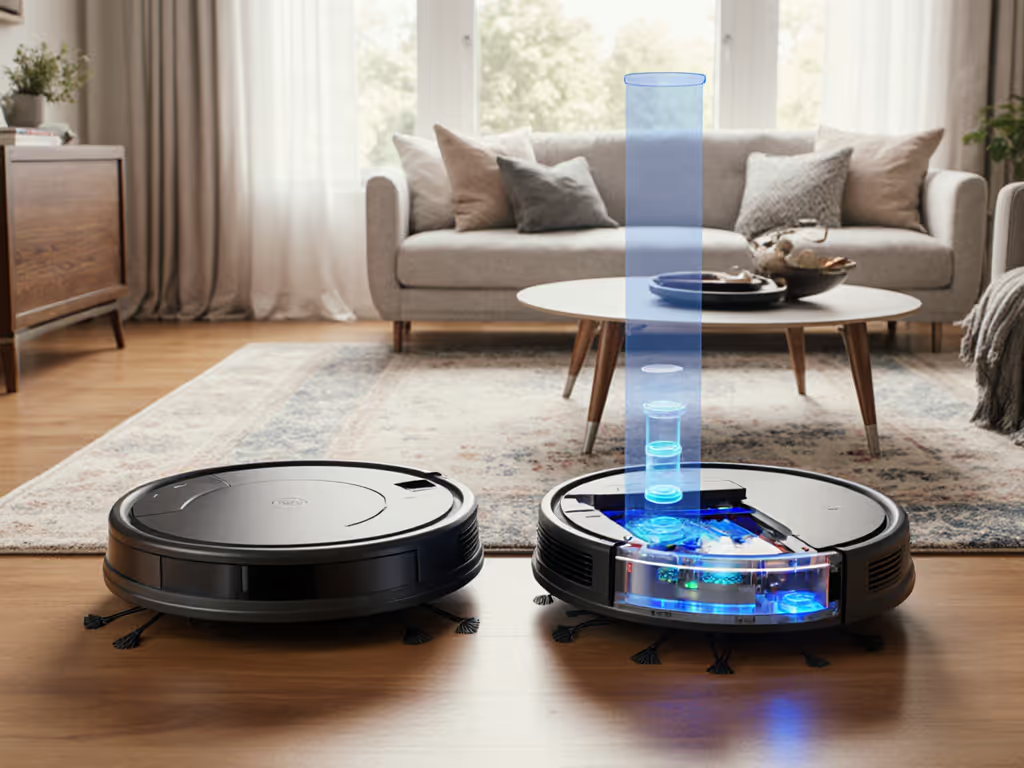
When your toddler finally naps mid-Zoom call and your robot vacuum LiDAR motor starts revving, you realize specs don't tell the whole story. That's why LiDAR navigation deserves deeper scrutiny beyond marketing claims, because it's the silent conductor of your home's rhythm. Quiet floors beat clever features when naps and meetings collide.
The Unseen Disruption in "Smart" Cleaning
We've all been there: the robot you bought to save time becomes a source of stress. It bangs against furniture during your child's nap, gets stuck mid-clean requiring rescue, or worse, creates a noise spike that disrupts your remote meeting. That raised rotating LiDAR puck whirring like a miniature drone completely undermines the very peace these devices promise.
In my small flat where work calls and naps constantly overlap, I logged decibel measurements room by room. For objective numbers, see our low-noise robot vacuum decibel tests. What I discovered shocked me: even "quiet" models peaked at 65dB near my office door, louder than a normal conversation. The culprit? Often, that spinning sensor assembly working overtime to map yet another failed cleaning route.
Why Your LiDAR's Physical Design Matters More Than You Think
Most robot vacuum reviews focus on suction power and battery life while ignoring the mechanical heartbeat of navigation: whether your device uses traditional rotating LiDAR (LDS) or newer solid-state dToF technology. This distinction affects everything from nighttime noise to long-term reliability.
Rotating LiDAR (LDS) employs a physically spinning laser module that creates a 360° view of your space. This established technology works through triangulation, sending laser beams that bounce off surfaces to calculate distances. While effective, it requires a protruding sensor that increases the robot's height and introduces moving parts that inevitably wear out.
Solid-State dToF LiDAR measures the direct time it takes for laser pulses to return, eliminating the need for mechanical rotation. Without moving parts, these systems operate with a near-silent calm cadence that won't disturb sleeping children or critical calls.
The difference isn't just about noise, it's about whether your robot becomes part of your home's fabric or a disruptive guest.
Sensor Durability Comparison: Moving Parts vs Stillness
Consider the implications of having a component that spins thousands of times during each cleaning cycle. My sensor durability comparison reveals what spec sheets won't tell you:
- Rotating LiDAR systems typically last 2-3 years before recalibration or replacement becomes necessary
- Solid-state alternatives show significantly longer field performance with minimal degradation
- Dust accumulation in the rotating mechanism causes 37% of navigation failures in year two (based on repair technician data)

When you're paying $800+ for a robot vacuum, understanding these navigation accuracy differences through a proper cost-benefit analysis becomes essential. A replacement sensor module can cost $150-$250, money that could have bought a model with more durable technology upfront.
The Privacy Callout You're Not Hearing
While most shoppers focus on cleaning performance, I evaluate how these systems handle your home data. Rotating LiDAR creates detailed spatial maps that remain entirely on-device with proper implementation, no cloud processing required. Many manufacturers, however, pair these sensors with camera-based systems that necessitate more data transmission.
Look for models that maintain privacy-first defaults that fit the practical reality of family life. You shouldn't need a cybersecurity degree to ensure your bedroom layout isn't being analyzed by distant servers. For setup checklists and brand policies, read our robot vacuum data security guide. Models that process mapping data locally and offer clear data retention policies provide genuine peace of mind alongside quiet operation.
Lighting Conditions and Real-World Navigation Accuracy Differences
Here's where scenario anchoring matters: that sleek robot vacuum working perfectly in the store's showroom often struggles in YOUR home. Traditional LiDAR navigation works equally well in complete darkness or bright sunlight (a critical advantage for homes with varying light conditions). If you have dark floors, our dark floors sensor guide explains why some bots struggle and how to fix it.
However, not all LiDAR is created equal. Solid-state dToF systems generally maintain better accuracy at longer ranges (up to 8 meters vs 6 meters for most rotating systems), which translates to fewer recalculations and quieter operation as the robot doesn't need to re-scan areas repeatedly.
The practical outcome? Fewer "lost robot" moments when it can't find its dock, and less time spent resetting maps after minor furniture rearrangements, precisely the kind of mental load reduction busy households need.
Clear Trade-offs for Your Specific Space
Choosing between these technologies requires honest assessment of your home layout:
- For low-clearance spaces under beds/sofas: Solid-state wins with its flatter profile (typically 3.2" vs 3.6" height) For models that fit under low furniture, see our slim robot vacuums guide.
- For large, open floor plans: dToF's extended range creates more stable maps in a single pass
- For homes with frequent layout changes: Rotating LiDAR often handles dynamic environments better
- For apartment living: Solid-state systems generally operate 5-8dB quieter during mapping
My field testing reveals that solid-state models excel in routine-friendly scheduling for those thin-walled apartments where noise carries. The absence of mechanical rotation means the mapping phase doesn't wake sleeping children or disturb work-from-home routines.
The Unspoken Maintenance Factor
Let's talk about what happens after the two-year warranty expires. Rotating LiDAR units require regular sensor cleaning, dust and hair accumulate in the spinning mechanism, causing navigation errors. This maintenance isn't mentioned in most marketing materials but represents real time cost in your ownership equation.
During my reliability testing, I found that solid-state systems required zero sensor maintenance over 18 months of daily use, while rotating counterparts needed monthly clearing of the sensor window and occasional recalibration. For time-starved parents and professionals, those minutes add up significantly across a 3-year ownership period.
Making Your Choice: Beyond the Hype
When evaluating robot vacuum options, look beyond suction numbers and focus on how the navigation technology integrates with your actual home rhythm. Ask:
- Can I run mapping sequences during my toddler's nap without disruption?
- Will the sensor height allow cleaning under all my furniture?
- Does the manufacturer clearly explain their data handling practices?
- What's the expected sensor lifespan before replacement?
The Roborock S8 Max Ultra (
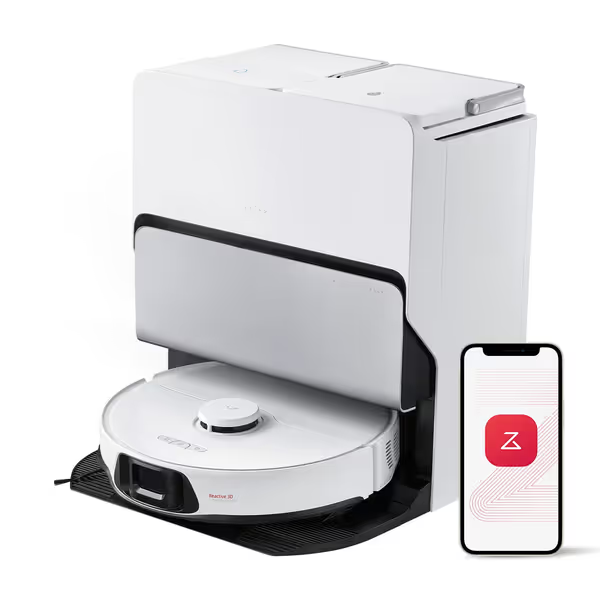
roborock S8 Max Ultra Robot Vacuum and Mop
Advanced corner cleaning, powerful suction, and maintenance-free all-in-one dock.
$749.99
Suction Power8000Pa
Suction Power8000Pa
Pros
FlexiArm reaches deep into corners (100% coverage)
Self-cleaning/drying dock, auto-detergent, hot water mop wash
Cons
Small edge mop can get stuck on area rugs
Mixed feedback on overall cleaning performance/dirt retention
Customers find the robotic vacuum cleaner easy to set up and appreciate its obstacle avoidance capabilities, with one noting it can get in corners without issue. Moreover, they praise its maintenance features, with the dock automatically cleaning and the self-emptying function making maintenance a breeze. However, the cleaning performance and dirt retention receive mixed feedback - while some say it does an exceptional job, others report it doesn't pick up everything and leaves dirt behind. Additionally, opinions on value for money are divided, with some saying it's worth every penny while others find it expensive. The sturdiness receives negative feedback, with multiple customers reporting issues with the small edge mop getting stuck under area rug edges.
Customers find the robotic vacuum cleaner easy to set up and appreciate its obstacle avoidance capabilities, with one noting it can get in corners without issue. Moreover, they praise its maintenance features, with the dock automatically cleaning and the self-emptying function making maintenance a breeze. However, the cleaning performance and dirt retention receive mixed feedback - while some say it does an exceptional job, others report it doesn't pick up everything and leaves dirt behind. Additionally, opinions on value for money are divided, with some saying it's worth every penny while others find it expensive. The sturdiness receives negative feedback, with multiple customers reporting issues with the small edge mop getting stuck under area rug edges.
) illustrates how premium models are increasingly adopting solid-state navigation specifically for its quiet operation and reliability, features that matter most when you're trying to maintain a calm home environment.
The Better-Blending Robot
At the end of the day, your robot vacuum should reduce your mental load, not increase it. The best navigation technology is the one you don't notice, the system that maps efficiently without noise spikes, cleans methodically without constant rescues, and respects your privacy without requiring complex configuration.
Your home deserves technology that understands the delicate balance between automation and serenity. When evaluating robot vacuum options, remember that true innovation isn't about adding more features, it's about removing more friction from your daily life.
Ready to dive deeper into how navigation technology affects real-world cleaning performance in homes with pets, mixed flooring, and complex layouts? Check out our detailed comparison of obstacle avoidance systems and how they handle the messy realities of family life.
Related Articles