Top 3 Stair Climbing Robot Vacuums: Eufy, Dreame, Mova
By Hana Takeda • 29th May
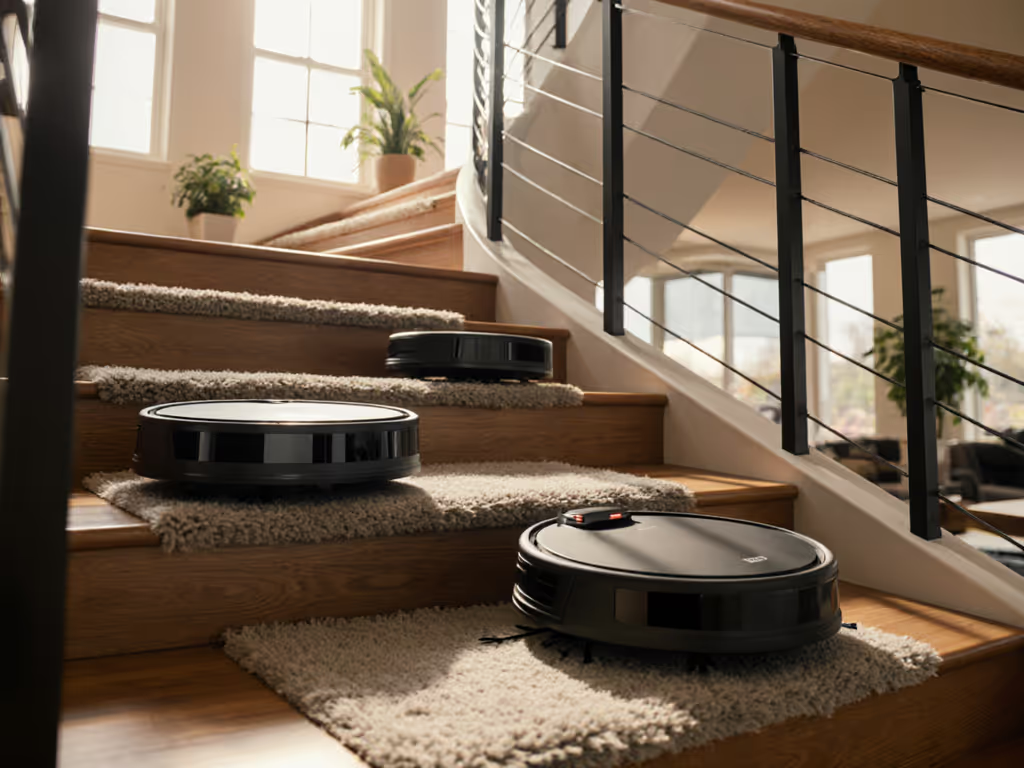
Stair-climbing robot vacuum cleaner concepts are finally moving from sci-fi slides to on-stage demos, and three names dominate this first wave: Eufy, Dreame, and Mova. If you live with pets, rugs, and stairs, the obvious question is whether these systems will actually reduce your workload, or just add another gadget to babysit.
As someone who tests robots in hairy, high-traffic homes, I'm going to treat these as I would any new mechanism: break down their vertical mobility systems, look at step navigation technology and stair safety mechanisms, then translate all that into real-world multi-floor cleaning efficiency for a busy, pet-heavy household.
Pet hair tells the truth about brushes, bins, and seals.
These stair modules won't change that truth, but they can change how your vacuum moves between floors.
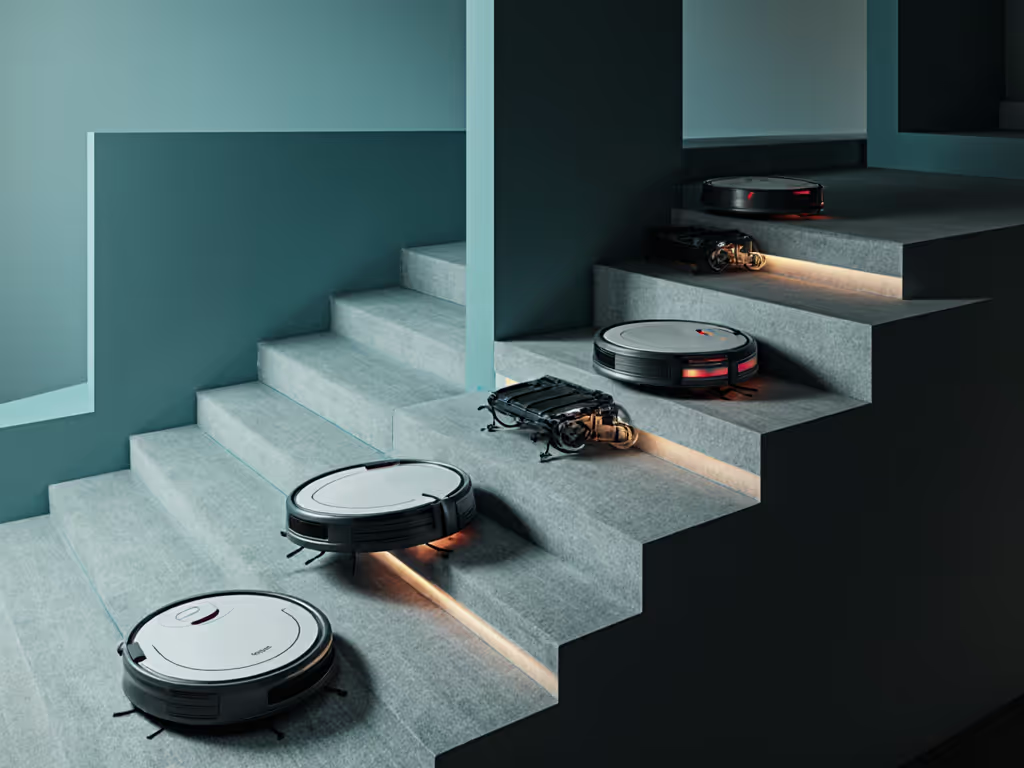
What "Stair-Climbing Robot Vacuums" Really Are (Right Now)
Before we rank anything, you need a clear reality check:
- You cannot currently buy a mass-market robot that climbs a full flight of stairs and is officially sold for normal home use.
- What Eufy, Dreame, and Mova have shown are concept stair-climbing modules that carry a standard robot vacuum between floors.
- None of these systems are designed to vacuum the stair treads themselves; the goal is to move the robot safely from one level to another.
According to Dreame's own explainer, engineers are testing multiple approaches to stair climbing, but commercial models are still emerging and "you can't buy a robot vacuum that can climb a full flight of stairs" today. IFA 2025 in Berlin was the first major public demo of these ideas from Eufy, Dreame, and Mova. For model-by-model results, see our stair-climbing robots tested.
From a mechanism standpoint, all three brands landed on the same basic idea:
- Use a separate carrier module that climbs the stairs.
- Let a relatively normal round robot handle the actual vacuuming on each floor.
That separation matters. The stair module is about mobility and safety. Your cleanliness, hair pickup, and odor control will still depend on the core robot's brush design, seals, bin size, and navigation, the same factors that already make or break robot vacuums in pet homes.
With that in mind, let's walk through the top three systems.
1. Eufy MarsWalker: Track-Based Speed With Bigger Footprint
Eufy's MarsWalker is a stair-climbing platform designed to carry compatible Eufy robots (shown paired with the Omni S2) between floors. Instead of adding legs to the vacuum itself, Eufy built a dedicated tracked carrier that acts like a stairlift for the robot.
How it moves
According to early reports from IFA 2025:
- MarsWalker uses four adaptive arms and a track-drive system to grip steps and climb them quickly.
- It can handle straight, L-shaped, and U-shaped staircases, thanks to onboard mapping and path planning.
- The module builds a 3D map of your home to plan its movements between floors.
- Once it reaches the next level, it releases the vacuum to continue cleaning.
Mechanically, this is a caterpillar-style vertical mobility system with extra articulation for balance. The tracks act as a continuous contact surface for step navigation technology, while sensors and mapping govern how it approaches and leaves each floor.
Safety and control
While Eufy hasn't publicly detailed every stair safety mechanism, the track design plus multiple contact points suggest a strong bias toward stability rather than flashy jumps. Think "industrial lift" more than "robot dog".
Key implications for a real home:
- Fail-safe behavior matters more than raw speed. You want it to stop and retry if alignment looks off, not power through a misstep.
- The 3D mapping means it should "know" where the staircases are, reducing the chance of confused wandering.
Space and footprint
VacuumWars notes that MarsWalker is track-based and mid-sized, not tiny. That means:
- You're effectively adding a second robot-sized device to your home.
- Dock placement becomes a planning problem: the module needs a clear path to the stairs and enough room at the top and bottom landings to maneuver and let the robot mount/dismount.
For smaller apartments with tight landings, this can be the limiting factor, not the tech itself.
Pet and rug reality
For pet homes, here's the critical distinction:
- MarsWalker only moves the vacuum; it does not improve brush geometry, bin size, or hair handling.
- Your actual cleaning results still depend on the Eufy robot you pair with it. If pet hair is your main issue, start with our anti-tangle robot vacuums comparison.
If your current robot already struggles with:
- medium-pile rugs,
- long hair wrapping around the brush,
- or basic threshold success between rooms,
MarsWalker will simply move a mediocre cleaner between floors more efficiently.
Best fit: multi-level homes with fairly generous staircase landings, where you already trust (or plan to buy) a strong Eufy robot and want fast floor-to-floor transfers without lifting a finger.
2. Dreame CyberX: Aggressive Tracks and Multi-Floor Ambition
Dreame's CyberX is arguably the most aggressive of the three in terms of technical claims and theatrical design.
At IFA 2025 and in subsequent coverage, CyberX is described as a caterpillar-track platform that carries Dreame robots up and down stairs. A Popular Mechanics piece also highlights a later Dreame stair-climbing concept with spider-like legs, showing that the brand is actively exploring multiple stair-climbing form factors.
How it moves
From available reports:
- CyberX uses treaded wheels/tracks that grip the edge of each step.
- It relies on step-by-step climbing, tilting the platform to pull the robot over each riser.
- Dreame claims it can climb steps up to 25 cm (about 9.8 inches).
- It features a triple braking system, designed to prevent uncontrolled sliding or falls.
- The carrier has its own 6,400 mAh battery and is pitched as supporting up to five floors in a home.
In other words, this is a high-end vertical mobility system with distinct attention to stair safety mechanisms (triple brakes, controlled tilt) and ambitious multi-floor cleaning efficiency (up to five levels per charge).
Safety vs. drama
The combination of caterpillar tracks and triple braking is telling:
- The tracks give strong contact on stair edges, even with slight overhangs.
- Braking redundancy is there to counter worst-case scenarios: slipping on a rounded nose, hitting a wet step, or encountering debris.
From a skeptical standpoint, any mechanism that tilts a heavy robot plus platform over every riser has two main failure modes:
- Misalignment at the first step (bad initial approach).
- Loss of traction mid-climb (dust, moisture, or worn tread).
CyberX's triple braking is the right answer on paper, but its real-world reliability will depend on ongoing tread condition and step uniformity, things marketing materials rarely dwell on.
Multi-floor households
If the five-floor claim holds up at launch, CyberX will appeal strongly to:
- townhomes with 3+ levels,
- multi-story homes with a basement plus multiple upper floors,
- or homes where you want one robot to handle everything rather than owning two or three lower-end units.
But there are trade-offs to flag for a time-starved owner:
- More moving parts than a conventional dock.
- A second battery to eventually replace.
- Likely higher upfront cost and more complex service/support needs.
And again: the carrier doesn't improve hair pickup. In my own testing with a shepherd and two rugs, the robots that won weren't the ones with the loudest motors; they were the ones with better brush geometry and sealed paths that kept hair flowing into the bin instead of wrapping. A fancy stair module won't change that equation.
Best fit: tech-comfortably early adopters in tall, multi-level homes who are willing to pay for a single, central system, and who are ready to maintain both a premium Dreame robot and its stair carrier over several years.
3. Mova Zeus 60: Compact Elevator-Style Lifter
Mova's Zeus 60 takes a different approach: instead of tracks, it uses a compact scissor-lift leg system that raises and slides the robot from step to step.
How it moves
Based on IFA coverage and Dreame's stair-climbing overview (which references this design type):
- Zeus 60 uses lifting legs to raise the robot up, then pull the front wheels onto the next step before bringing the rest of the body along.
- It moves more like an elevator-style platform, with compact up-and-forward motion rather than long tracks.
- Some demo units with similar scissor-lift designs have handled curved or spiral staircases and step heights up to about 10 inches (25 cm).
- The system is described as slower than tracks, but very stable.
VacuumWars characterizes Zeus 60 as compact and space-efficient, but noticeably slower compared with Eufy's and Dreame's tracked modules.
Space and staircase compatibility
The main strengths of this design:
- Smaller footprint: easier to park near a staircase without dominating a landing.
- Potentially better on non-straight stairs: scissor-lift mechanisms can reposition the robot in smaller increments, which helps on curved or spiral runs.
On the other hand:
- Speed will be the obvious sacrifice, if MarsWalker sprints, Zeus 60 strolls.
- The mechanism may be more sensitive to irregular step dimensions or loose carpets/runners on stairs.
Safety characteristics
The elevator-style platform's big advantage is psychological as much as mechanical: the robot looks like it is being cradled rather than balancing on stair edges.
From a risk perspective:
- Fewer sudden tilts means fewer scenarios where a miscalculated angle throws off the center of gravity.
- The trade-off is that the module has to execute more, smaller motions correctly.
For families with kids and pets moving up and down the stairs, the slower, contained movement might feel safer, even if the underlying risk profile ends up similar on paper.
Best fit: homes with tight or curved staircases and limited landing space, where raw speed is less important than a compact device that doesn't get in the way.
Side-by-Side: Which Stair System Matches Which Home?
Here is a simplified scenario comparison based on what is currently known:
| System | Vertical mobility style | Relative speed | Staircase types it targets | Space footprint | Headline strengths | Likely trade-offs |
|---|---|---|---|---|---|---|
| Eufy MarsWalker | Tracked platform with adaptive arms | Fast | Straight, L-shaped, U-shaped staircases | Mid-sized | Speed and flexibility; 3D mapping for paths | Larger footprint near stairs; another complex device to maintain |
| Dreame CyberX | Caterpillar-track carrier with safety braking | Fast-medium | Standard stairs up to ~25 cm risers | Likely mid-to-large | Triple braking; claims support for up to 5 floors | More moving parts; second battery; likely high cost |
| Mova Zeus 60 | Compact scissor-lift / elevator-style platform | Slow | Straight and some curved/spiral stairs, up to ~25 cm steps | Compact and space-efficient | Stable, visually controlled lifts; small footprint | Slower transitions; potential sensitivity to irregular steps |
Remember: all three are modules. Your actual cleaning results still depend on the robot they carry, its brush, seals, bin, and mapping.
How These Systems Stack Up Against Real-World Pain Points
1. Babysitting and reliability
Pros:
- Auto floor-to-floor transfer means you no longer have to carry the robot upstairs yourself.
- If the mapping is solid, you could schedule sequential runs (basement → main floor → bedrooms) without lifting a finger.
Risks:
- New mechanisms mean new ways to get stuck or fail, especially on non-standard stairs, loose runners, or cluttered landings.
- All three rely on the robot's own cliff sensors to avoid falling off individual steps, the same technology current robots use to avoid stairs altogether.
If your current robot already needs frequent rescues from cords, rugs, or thresholds, adding a stair carrier is like putting it on a ski lift, and it may reach the top just to get stuck on the first tasselled rug. To cut down on those rescue missions, see the top obstacle avoidance vacuums.
2. Pet hair, rugs, and odor
None of the stair modules addresses the core pet problems:
- Brush design and anti-tangle behavior
- Sealed airflow path across mixed floors
- Bin size or self-emptying capacity
Those are properties of the base robot. In my own lab notes, the keepers are the ones that stay tangle-light and climb without drama, week after week. That will still be true in a stair-climbing era.
So if you're a pet owner, prioritize:
- Tangle-resistant brushes
- Strong edge pickup on rugs
- Solid threshold success between hard floor and carpet
Only then does a stair module become worth considering as an add-on.
3. Mapping, apps, and multi-floor logic
The early tech focus is clearly on:
- 3D mapping for path planning to and from staircases (Eufy).
- Multi-floor support claims (Dreame up to 5 levels).
But the usual app frustrations (room naming, zone cleaning, lost maps after updates) will still live in the robot's software, not the stair module itself. Our robot vacuum app guide explains mapping, custom zones, and multi-floor setup that actually works. If you already dislike a brand's app, the carrier will not fix that.
4. Cost of ownership
Pricing isn't public yet, but mechanically complex modules with extra batteries and motors will not be cheap. Expect:
- Higher upfront cost than a standard robot + dock.
- Additional parts to eventually service: tracks, lift mechanisms, safety sensors, wear items.
If you're ROI-driven over a three-year window, compare:
- One high-end robot + stair module, vs.
- Two mid-to-high robots, one per floor.
In many homes, two separate units still win on simplicity and redundancy. For long-term value, review our data on reliability and 3-year cost.
Final Verdict: Should You Wait for Stair-Climbing Robots?
From a mechanism perspective, I'm excited. From a buyer's perspective, I'm cautious.
Here is the distilled guidance:
- If you are an early adopter with a tall, multi-level home and you already like Eufy, Dreame, or Mova's robots, these stair systems are worth watching, and possibly testing, once they move out of concept status.
- If your primary pain points today are hair tangles, poor rug performance, noise, or unreliable mapping, your time and money are better spent on a proven robot with excellent brushes, seals, and navigation right now, even if you still carry it up the stairs yourself.
- If you live in a typical 2-floor home, consider two strong, pet-capable robots (one per level) before betting on a first-generation stair module.
Stair-climbing tech will eventually help with multi-floor cleaning efficiency, but it does not change the fundamentals of how well a robot cleans. For a busy, pet-heavy household, it is still smarter to buy the vacuum that can quietly handle your hair, rugs, and thresholds, then decide whether a stair carrier adds real value once the first consumer versions have proved they can survive a few years of real stairs, real kids, and real pets.